

If you know your income goal, your prices and roughly how many views you get, you can reverse engineer exactly what it would take to hit that goal: how many sales a month, how many views, how often you’d have to post. It’s just simple addition and multiplication. I was SO bad at math in school, trust me. Anyone can do this.
And it’s the thing I see creatives skip more than almost anything else. Virtually every creative I’ve ever worked with undervalues themselves, and a lot of the time it’s because they’ve never sat down and run their numbers.
So here’s all of the art business math I do with my students (and did for myself, back before I went full-time), in one place.
What does “doing the math” actually mean for an artist?
When I was in college and thinking about going full-time, I was unbelievably stressed out about it. I’d been posting consistently for almost a year, graduation was on the horizon, and no one in my life could give me a road map.
I am, constitutionally, a very anxious person. If I have anxiety, I will make a list. I’ll make a flowchart. I’ll make a spreadsheet.
So I did a thing that, looking back, I think changed the trajectory of my life forever.
I made a plan.

A very simple plan of how much money I’d make from where. This many prints at this price point. This many brand deals at this price. Freelance work at this many dollars an hour.
Did I follow that plan exactly? No, of course not. But I think it’s one of the biggest reasons I was able to go full-time in just two years and make six figures in three. Crunch the numbers and the impossible dream (making $50,000 a year, or six figures, or seven, who cares) turns into something tangible, because you can see the exact road map.
There are really three questions underneath all of it:
- How much does your business actually need to make?
- How many sales does that take?
- How much attention (views, followers, subscribers) does it take to get those sales?
How much does your art business actually need to make?
This is where most people get it wrong before they even begin.
Let’s say you wanted to make approximately the median annual salary here in the US. That’s about $60-ish thousand a year. A very middle-class lifestyle. You’re not going to be able to buy any Lambos, all right? It’s not greedy to want this.
If you run your own business, your revenue goal, very importantly, is NOT $60,000. That money isn’t free.
Replacing a $60K salary
With a 9-to-5, your employer covers part of those last ones. In your own business, nobody does.
To give you an example, my business brought in about $150-ish thousand in revenue in 2025. The portion I paid myself (my own salary) was about $40-ish thousand, probably a little less. And every single time I run payroll for myself, I pay about a thousand dollars in taxes.
So if you want to replace a $60,000 salary, your business has to bring in a lot more than $60K. Again, revenue. Not take-home pay.
(If that number makes you flinch, read the starving artist myth. And for how I split up every dollar that comes in, here are my money rules for a creative business.)
How many sales do you need to make $100K a year?
Once you have a revenue goal, take every product you offer and its price, and do the math. How many of each would you have to sell? What mix feels realistic?
Let’s do one together. Say you want to make $100K this year, and all you want to sell is a $500 course. That’s your only revenue stream. That’s awesome. We can do that.
$100K from one $500 course
That's roughly one sale every other day.
Do you think you could find 17 customers a month? I believe in you. I think you could do that.
And notice I didn’t give you a number for the whole year. I said 17 every month. It’s a sales quota. A benchmark, a substantive, objective thing you can track, so you know exactly where you’re at. Basically every company with a sales team breaks goals down like this, because of how useful it is.
And if you already know what drives your sales (email marketing, posting content), suddenly you have a pretty good sense of how many emails you’d have to send and how many videos you’d have to post, too.
This is so powerful, and no one does it.
Fewer, bigger sales make the math easier
There are two roads here. Go for volume and get as many orders as possible (which means posting even more), or raise your average order value.
Same money, two roads
I know the answer for me personally. Going for average order value usually means more high-ticket products (like a painting), or bundles: a small original and a print together, a print and a sticker, your entire animal pin collection. (More on this in how to sell art with no followers, which is all about making your first $1,000.)
How many views do you need to make a living as an artist?
This is where the math gets really eye-opening.
Joseph is a dark fantasy artist and a member of the Creative Accelerator. He sells enamel pins, prints and tapestries. He quit his job to go full-time with four months of financial runway, and asked me what I’d do if I were him.
The first thing I did was run the numbers. You need three of them: how many views you get a month, how much revenue you bring in, and how much revenue you WANT to bring in.
Joseph's four-month math
That's about seven Reels a day.
A view is worth about 2 cents to Joseph. Don’t spend it all in one place!
Seven Reels a day is impossible. Nobody is doing that. But that’s the reality if nothing else changes. Lucky for us, we can change some things.
Views on their own don’t pay you
People mix up “views” and “income” constantly.
One month of YouTube AdSense
Not even 5% of my monthly revenue.
If I was making only around $500 a month, that wouldn’t be a business. YouTube AdSense is never going to be your money maker. Your products are. Views only turn into a living when they lead somewhere: your shop, your email list, your offer. (More in YouTube’s monetization changes.)
How many followers do you need to sell your art?
(For the deeper answer, including why your prices matter more than your follower count, read how many followers do you need to be a full-time artist?)
Fewer than you think.
Joseph had only about 3,400 followers when we ran his math, and follower count wasn’t part of the math at all.
No matter how many views you’re getting, people won’t buy if they don’t know what you’re selling: that it exists, what it is, who it’s for and how it can help them. People only ever see a fraction of what you post. They only watch like 30% of your videos. So if you want more sales, you have to sell more consistently.
You might genuinely not even need more followers. You might be able to 10X your business just by selling to the ones you already have.
And not every follower is worth the same. An email subscriber is about 40 times more valuable than a follower on Instagram. They’ve indicated interest, and they’re on a platform you control. Over Labor Day weekend, I sent one email to my list (and resent it to the people who didn’t open it) and made $2,800.
How do you make each view worth more?
Back to Joseph and his 200 Reels. There are two levers.
Lever one is views. Post better, or post more. But I don’t want outliers (a couple of viral videos) to be part of our strategy. I don’t want to count on them.
Lever two is the value of a view. And there are a bunch of ways to raise it:
- Better calls to action. One in every single Reel and every single post.
- Lower friction. A ManyChat automation (comment a keyword, get a link automatically) can send someone straight to the product page for a specific pin or print. Way better than a link to your whole site in your bio.
- Bundles. Anything under about $100 on socials is pretty close to an impulse buy.
- Order bumps. “Hey, I noticed you had this in your cart. Do you want to add this too?” An average take rate might be 5 to 15% or higher. That’s free money. I don’t know how else to say it.
- Upsells. After checkout: “People who bought this also got value out of this.” A certain percentage will take it.
- Email. Collect emails in that same ManyChat flow, so even someone who doesn’t buy might join the list.
I’ve seen people 3-5X their monthly revenue by implementing those easy fixes.
If a view is worth three times as much
About two a day. Way more doable.
Calls to action sound almost too small to matter. Here’s what one student shared after my CTA workshop:
3–10% click-through to my Patreon EVERY TIME since the CTA workshop.
 ItsWarlockJemma · artist
And Joseph shared this in the Accelerator’s wins space after making $8,775 in two Ren Faire weekends (more than all of last season):
In this economy, to see doubling of revenue is crazy to me. It means that what I’m doing is working - it’s not just luck.
 Joseph Zhou · dark fantasy artist
(There are more of these on the student wins page.)
What if you’re getting views, but nobody’s buying?
Then your problem is conversions. People are landing on your sales page and seeing your offers… but not pulling out their wallet.
When that happened to me, three things worked immediately: a countdown timer and a testimonial in every sales email, more specific calls to action (“get my exact system” instead of “buy the workbook”), and actually asking people why they didn’t buy. Understanding why your leads are not taking action is maybe one of the single most important pieces of data you can get in your business.
It also helps to sell to people who already bought from you. My emails to past customers (tagged by what they purchased) convert WAY better than the ones to my whole list, because those people already trust my work enough to buy it once. (The full breakdown is in the three bottlenecks of a creative business.)
Are you undercharging? Do the math on your hourly rate
Sometimes the math doesn’t tell you to post more. It tells you to charge more.
One of my students runs a paid mentorship: one-on-one with a client, once a week for a month, for around $300. When I heard that, I thought, “Man, for 4 hours of one-on-one coaching a month, that’s kind of a steal.”
Then she said the meetings weren’t actually an hour long. She was so worried about providing value that they ran THREE hours on average. Plus asynchronous feedback.
The $300 mentorship
And she could take two clients a month, max.
It was only when we did the math together and I showed her she was making 20 bucks an hour that she understood how much she was undervaluing herself, teaching skills she’s spent years developing.
She just hadn’t done the math.
I told her to double, if not triple, her prices if she wanted to deliver that same experience to anyone else.
This shows up in the offers bottleneck too. Maybe you’re doing $4K, $5K, $6K months but can’t break through to consistent $10K months. If you have leads and conversions and you’re still not hitting your goals, your offers aren’t valuable enough, or priced high enough, to get you there. Maybe you’re so focused on $20 prints that you’re neglecting the customers who would GLADLY pay you $2,000 for a commission.
There are people out there who are more than happy to pay 10x what you’re charging right now. But if you don’t believe anyone would pay more, you won’t offer anything at that price.
Emily Hare, who paints little monsters, is a good example. One of her posts did 2.4M views, three monster sculpts sold in her next drop, and she relaunched her prints at $40 to $50 instead of the prices she used to charge.
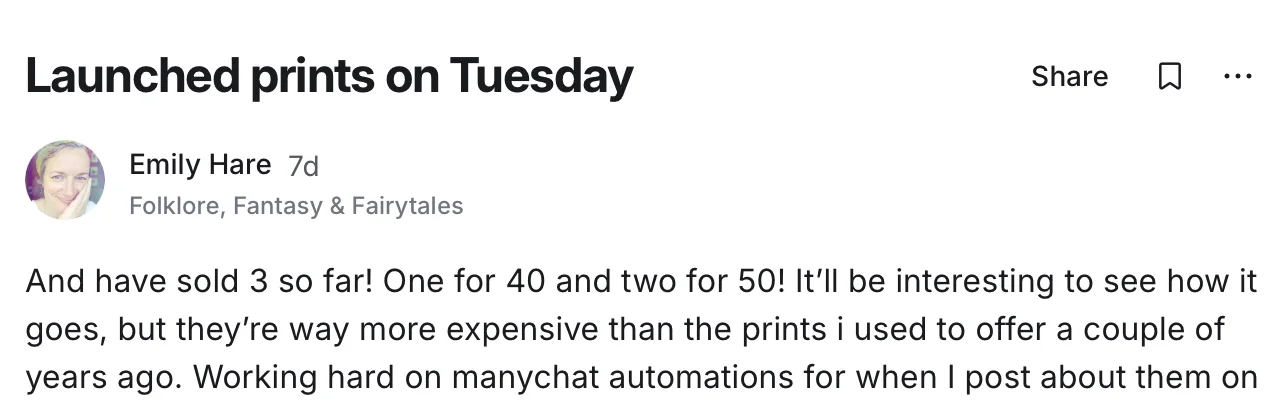
(For raising your prices and holding the line, read stop undercharging for your art. For why a range like $20 to $2,000 made the biggest difference in my own business, see how to double your revenue.)
What if the math says you have to post every day?
Sometimes you do all of this and the answer is still hard.
Even in the luckiest world, where we triple the value of a view, Joseph was still looking at posting probably every single day. The math was indisputable.
To be so clear: most of you are not under this time pressure. You can spend 18 months doing all of this instead of four.
But when I showed Joseph the volume of content his goal would take, he was still all in. He pushed all his chips forward on the poker table and said, “Let’s do this.” So our conversation shifted to the systems he’d need to post daily without burning out: simple formats, batching, and brainstorming content for one product at a time. (The whole plan is in how to become a full-time artist, and the first part of our conversation is in how do I go full-time in 4 months?)
And all of this assumes his views stay exactly the same. They won’t. Post that much and keep working on your hooks, and you get better. The math gets easier from there.
What numbers should you check every month?
Doing the math once is great. The real power is in checking it.
Guard against the obsession with vanity metrics: follower count, even views or likes. Likes can’t pay your bills. Track conversions, not vanity metrics.
The simplest way is to be observant. When sales or sign-ups spike, ask what happened just before. What did I post? What format? Did I have a call to action, and what was it?
Inside the Creative Accelerator, this becomes a monthly habit. On the first of the month, you check three numbers (list growth, open rate, sales) and you know what to do about each one. Plus your sales quota: did you hit it, or not? (For the other weekly habits that grew my business almost 50% in a year, read five habits to make $10K a month.)
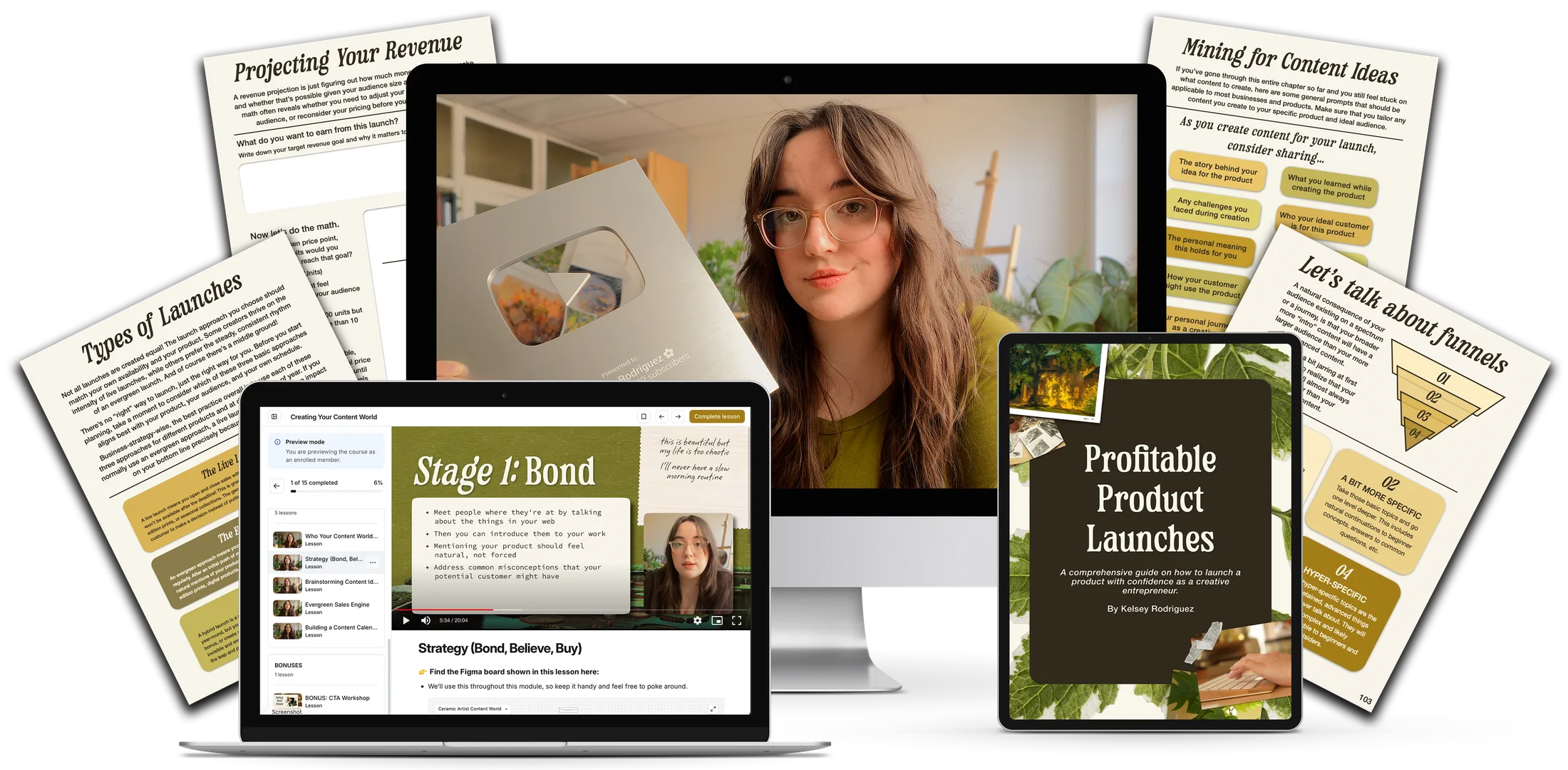
the one I'd pick for you…
The Creative Accelerator
A year of hands-on support for creatives scaling to six figures. We run your numbers together every month (and I tell you what to do about them), plus group coaching twice a month, co-working every other week, my feedback on your content, and every course I make.
Learn moreWhere to go next
If you do one thing after reading this, run your numbers. Figure out whether your current business model will support the life you want to live. The free Creative Money Map is kind of tailor-made by me to go along with this exact topic.
Then, depending on what the math tells you:
- You need more sales: how to sell art with no followers
- You need more views: how to become a full-time artist
- You need higher prices: stop undercharging for your art
- You’re stuck at the same revenue: the three bottlenecks
- You want the money side organized: how to organize your creative business
Every time you think, “Oh, I could never make that much,” I want you to instead think about what it would take to reach that revenue. Doing the math makes that impossible vision feel REAL.
And if you want my whole system for running the numbers and acting on them every month, that’s what the Creative Accelerator is for.
Talk soon,