
If I had to start over and make my first $1,000 as an artist, I wouldn’t waste my time building a website, making a logo, or opening an Etsy shop. All you actually need to sell art with no followers is your art, your phone, and an internet connection. That is genuinely it.
I’ve helped hundreds of artists go viral, fully fund their Kickstarters, sign $2,000 clients, and go full-time. And what I’ve learned is that artists, especially in the beginning, make their business way too complicated. It ruins their profitability, and it makes everything feel overwhelming.
So if I was starting from scratch, here’s exactly what I’d do.
Why short-form video is the fastest path to your first $1,000
I love YouTube so much, but the shortest path to $1,000 is short-form video.
I can ideate, script, film, and edit a Reel in 20 minutes. (I’ve timed myself.) A YouTube video takes me days: hours on the script, eight to 10 hours editing, minimum. In one YouTube production cycle I could film like 20 Reels.
In the beginning, the name of the game is iteration. Testing, throwing stuff at the wall, seeing what sticks. I’ll say Instagram throughout, but this works on TikTok, YouTube Shorts, you name it.
Step 1: Fix your content strategy (make content for customers)
So many artists on socials share still photos of their work with no context, no story, no emotion. And story and emotion are what actually attract customers.
Customers long for story. They long for emotion and connection, and depriving your customers of that is costing you sales.
So I’d make two to four videos a week about:
- What my creative practice means to me
- Why I create the art I do (my subject matter, my medium, my process)
- Repeated motifs or symbolism in my work, and how they connect to my ideal customer
- The worldview or philosophy in my work (I’d talk about that so much people would be annoyed)
- How I want someone to feel when they live with my work
That last one matters a lot. Customers aren’t just buying the pretty thing. They’re buying a feeling, a reminder, an identity. The more we can focus on that true desire beyond just the pretty thing, the more effective our marketing will be.
An example from one of my paintings
I took the reference photo for one of my paintings on a road trip with friends. I loved this tree. The arc of the branches looked so majestic that I had an arch panel custom made for it.
Then a solar flare brought the northern lights all the way down to the Bay Area. I drove out and took long-exposure photos of a very pink sky, and I mashed those together with the tree to give it the magic I thought it deserved.
To me, the world is hard. But there’s so much magic in the mundane, and it’s there if you want to see it.
That’s what I’d say to sell that piece.
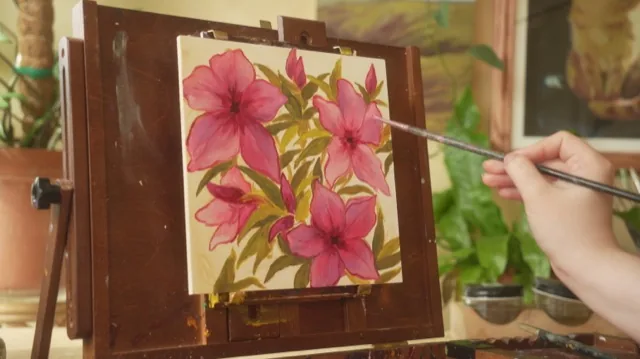
You don’t need fancy editing. You need decent lighting, halfway good audio, and ideally your face. (I know, I’m sorry. But humans are just really compelling.)
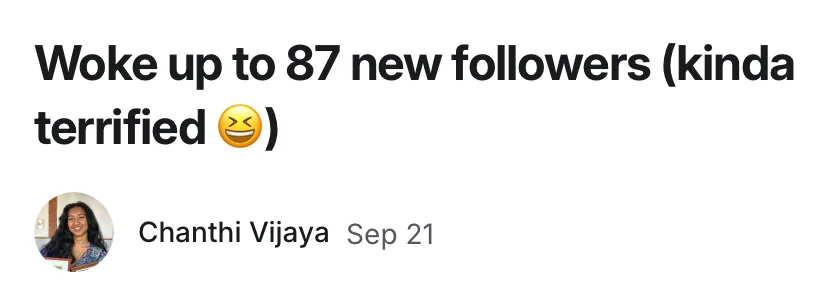
One of my students, Chanthi Vijaya, paints birds and flowers. Her posts were getting a couple thousand views. During my Creating Your Content World challenge, her next one did 98.8K, and she woke up to 87 new followers.
for when you're ready to commit…
Creating Your Content World
The program Chanthi was in. Seven weeks live with me and a room full of creatives, writing the story-first posts from this step together and roasting them before they go out.
Join the next cohort(Related: why you should stop trusting your gut on content.)
Step 2: Raise your average order value
To make your first $1,000, you can go for volume (as many orders as possible, which means posting even more) or raise your AOV, average order value. As an oil painter, I’d go for AOV.
Two roads to $1,000
Same money. I know which one sounds easier to me (the 20).
AOV means higher-ticket products (like a painting) or bundles. A small original and a print, a print and a sticker, your entire animal pin collection. You’re already paying for shipping, you move more inventory, and your customer has to decide less. I buy the bundle myself all the time (there’s usually a discount, and the bundle just gives me more of the thing I already want).
(Need ideas for what to bundle? Grab my free list of product ideas.)
Step 3: Sell in your Instagram stories (not on a website)
Kind of crazy, but: no website, no Etsy shop. Sell in your stories.
If you’re posting Reels a few times a week, new people are already watching your stories. And new followers (the exact person you just told your story to) probably want to buy from you, or are at least very suggestible.
So a story like: “Hey, my name’s Kelsey. I have this piece I just finished. Do you want to buy it? It costs this much. Just reply to me to purchase.”
That’s so simple. Someone replies, I send them an invoice. A website only adds friction right now. It takes time and money to build. No, thank you. (More wording like this in what to say when selling your art, and the full scripts are in Selling Made Simple.)
I would have a story going out every single day, trying to sell a piece every single day. Same piece, a different one, a bundle. Up to you.
Step 4: Start an email list
So far this business has no operating expenses at all. (God, I wish.) But it’s all on Instagram, and I don’t love that long-term. So once some revenue is coming in, I’d start an email list.
An email subscriber is about 40 times more valuable than an Instagram follower. They’ve raised their hand, and you own your list. You can take it literally anywhere.
Whenever I send an email, I make money. On Labor Day I ran a sale on a bundle (there it is again) of my digital products and made over $2,800 from one email.
What should artists write in their emails?
The same things as your content: the stories, emotions, and origin of your work. Not process. Thoughtful, personal entries into your creative practice. (If you’re building a world, like a novel or a webcomic, talk about how you’re building it.)
Write emails people genuinely want to read, and you won’t need a 15%-off discount or a lead magnet to grow your list. The emails themselves are the value proposition. Then end each one with a quick call to action: “Hey, I have this piece available. Just so you know, it’s here. It might not be here next time.”
More in my guide to email marketing for artists.
Step 5: Now (and only now) build a website
Content is consistent, stories are selling, the email list brings more sales. Now I’d build a website.
As your views grow, the DMs get overwhelming. People ghost you. They want to haggle. None of that feels good. A website where the price is the price respects your time (and time is the one thing creative entrepreneurs don’t have much of). Maybe add a ManyChat automation that sends folks there.
Once you’re making $1,000 (or multiple thousands every month), that infrastructure is worth it. Not before. You don’t want a monthly expense your revenue can’t sustain.
Keep it simple and start scrappy
Simple content: the stories and feelings in your work. Simple sales: no big inventory spend, no expenses your revenue can’t cover.
You don’t need to be polished and perfect from the beginning.
You need to start.
For the content side in detail, here’s my full content strategy for artists, the same system that’s helping my students go from 4,000 views to over 400,000.
Talk soon,