
The reason your business feels like a chore right now is that you aren’t charging enough for your work. Plain and simple.
Undercharging can feel good in the moment. It feels like you’re making your work so accessible that you’re doing your customers a favor. But you’re sabotaging your own success, and you’re creating terrible incentives for delivering a good experience to those same customers.
That’s why you feel overworked and underpaid. So let’s talk about how to price your art like you mean it.
What undercharging actually costs you
Most of us started a creative business because we had a vision. A particular way we wanted people to feel after interacting with our work. Undercharging forces you to compromise on it.
It’s a brutal cycle. You don’t feel confident charging more, so you don’t. Then you can’t afford to give customers the experience you wanted, so you cut corners a little. Not unethically (you keep your promises), but you skip the nice packaging. You don’t add the little details. You don’t spend the time you wish you could.
It’s death by a thousand cuts. A tiny cut every time someone buys. It leaves you drained and creatively unfulfilled, and you’re still struggling financially. So you start asking: why am I even doing this? Am I cut out for this?
Undercharging makes you resent your customers
How could you not resent the person who’s forcing you to compromise your vision and not paying you what you’re worth?
But your customers aren’t doing anything wrong. You never gave them the option of paying more. They only take what you give them. So you tell yourself no one would ever pay more, while never actually giving anyone the chance.
Charging more is doing your customer a favor
I know that sounds crazy, but hear me out.
When you charge more, you are doing your customer a favor.
When you charge a rate you’re honestly a little uncomfortable with, you’ll want to give that customer an amazing experience, and you’ll finally have the money, time and resources to do it.
Which world do you think customers like more?
- You undercharge, and you’re overworked and resentful.
- You charge enough that you feel a little nervous and hungry to make sure this person has an amazing experience, and you’re fired up, well-rested and finally creatively fulfilled.
It’s so obvious. It’s the second one. You stop resenting the people keeping your business alive, and they leave surprised and delighted, thinking, “I paid for that, for sure, but it was worth it to me.”
You will get pushback when you raise your prices
People will say, “Oh, I love your work, but I just can’t afford it.” They’ll ask for discounts. They might even tell you you’ve sold out.
It’s no secret that I don’t come from money. But I still do not understand people who walk up to a small business and try to haggle.
Girly, this is not a flea market.
The years you’ve put into your craft are worth you being able to thrive, not just survive. Groceries, healthcare, a house. Normal human things that are okay to want. So when the pushback comes, here are three things to do.
1. Anchor yourself in the experience you want to deliver
Say you’re an oil painter who does commissions. You want customers to feel seen and heard. You don’t want them chasing you for updates or going back and forth forever. You want to talk with them in advance and understand on a really deep level what they’re looking for (people who commission often don’t have a concrete vision at first, so you have to get it out of them), and where the piece will live in their home.
Giving someone what they want on the very first try, and making it feel easy, takes systems, attention and time. That necessitates a higher price. Same if you’re an educator: really sitting with your students’ problems and coming up with tailored answers takes time and energy.
When you undercharge, the juice isn’t worth the squeeze. So make it make economic sense, so you want to over-deliver. When someone objects, say something like:
“I’m not willing to compromise on this experience. I’ve worked with people where I was underpaid, and frankly it wasn’t enjoyable for me or for them. I want to move in a new direction. I want to be exceptional in my industry and known as someone who goes above and beyond. To do that, I have to charge a certain price. This is what it costs.”
And you just say that. (More help with exactly what to say: Selling Made Simple, and what to say when selling your art.)
2. Keep communicating the cost of charging less
There is a cost to charging less. We don’t like to talk about it. A lot of factories that charge businesses like ours very little can only do it because of horrible sustainability and labor practices. Shein can charge so little because the quality is terrible and the designs are stolen from independent artists just like us.
So remind customers you won’t make that compromise. Talk about how much time your work takes, the years you’ve spent learning your craft, the thoughtfulness behind it.
There’s a designer I follow who does this constantly. He talks about his own experiences and the quality of his materials, and he does an amazing job of making me want to pay $300 for a pair of jeans. Compare that to Shein’s content. Not even the same multiverse.
If everyone in your industry keeps charging less, anchor in quality. Make customers ask: what’s so exceptional about this that their price is the exception? The right customer will find that incredibly compelling.
3. Dismantle your own shame about money
Often the biggest downward pressure on our prices is us. We’re tangled up in guilt and shame, and we don’t want to be “too greedy.”
But it’s normal to pay yourself a living wage. The fact that we’ve convinced ourselves it isn’t is crazy. We are so deeply unwell.
And you can still make your work accessible. Charge what you’re worth at every level of your business. If something is built around access to you (your time, your brain, your creativity), charge what that’s worth. Make sure you can deliver the experience comfortably and still run a profitable business, with something left over beyond your wages to pay yourself extra or reinvest. (If you’ve never worked out your real hourly rate, do the math first. For the bigger picture, see money rules for your creative business.)
Prints, stickers and digital products can be your affordable versions. But for the things where you want to surprise and delight someone, set it up so you have the financial incentive to over-deliver.
Your work doesn’t have to be universally accessible
There are people out there who are more than happy to pay 10x what you’re charging right now. But if you don’t believe anyone would pay more, you won’t offer anything at that price, and the fear becomes a self-fulfilling prophecy.
Everyone can enjoy your free content. They just can’t all have an original in their home.
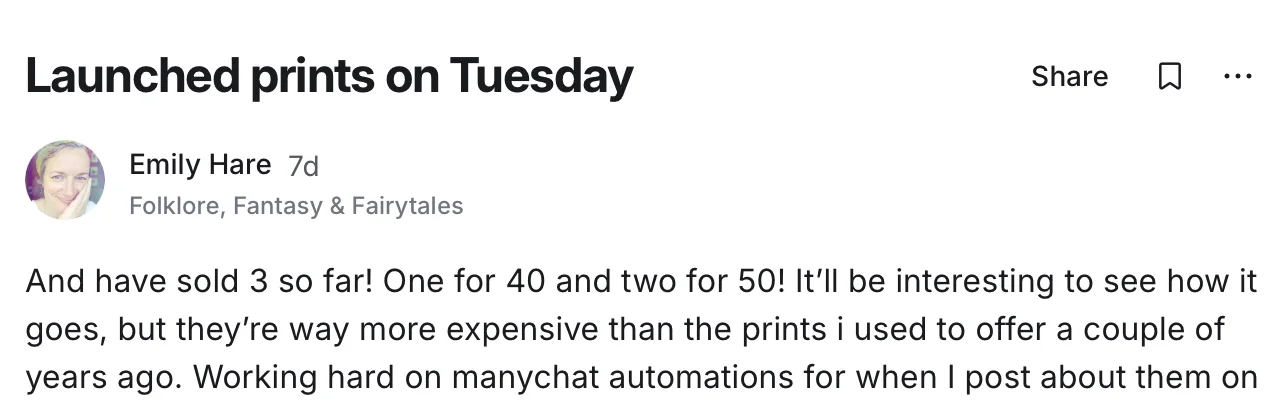
One of my students, Emily Hare (she paints folklore monsters), relaunched her prints at $40 to $50 instead of the prices she used to charge.
Charge more than you feel comfortable with. Your customers come away surprised and delighted, and you finally get to deliver the experience you always dreamed of giving them.
That’s a really good feeling. I want you to experience it.
Related reads: Starving artist? Not on my watch.
Talk soon,