
How many followers you need to make a living as an artist depends far less on your follower count than on what you sell and for how much. You might genuinely not even need more followers. My student Joseph had about 3,400 followers on Instagram when we ran his numbers, and follower count wasn’t part of the math at all.
So instead of a number, here’s the math I’d do with you. Plus a little rant about why nobody taught you this in the first place.
How many followers do you need to be a full-time artist?
Joseph is a dark fantasy artist and a member of the Creative Accelerator. He sells enamel pins, prints and tapestries. He quit his job to go full-time with four months of financial runway, and asked me what I’d do if I were him.
The first thing I did was run the numbers. You need three of them: how many views you get a month, how much revenue you bring in, and how much revenue you WANT to bring in.
Joseph's math (3,400 followers)
About seven Reels a day, if nothing else changes.
Seven Reels a day is impossible. Nobody is doing that. But that’s the reality if nothing else changes. And the thing you can change fastest isn’t your follower count.
It’s what a follower (or a view) is worth to you. That comes down to two things: what you sell, and how often you actually ask people to buy it.
Not every follower is worth the same, either. An email subscriber is about 40 times more valuable than a follower on Instagram. They’ve indicated interest, and they’re on a platform you control. Over Labor Day weekend, I sent one email to my list (and resent it to the people who didn’t open it) and made $2,800.
How many followers do you need to make a living as an artist? Look at your prices first.
Same income goal, wildly different audience. It all depends on the price of the thing you’re selling.
Same money, two roads
I know the answer for me personally.
Most of the artists in my audience already have their own products. Stickers, prints, originals, merch… whatever it is. And that’s an amazing foundation to have. But what you’re probably neglecting are high-ticket offers. Things that cost hundreds to thousands of dollars for your customers to purchase.
Low ticket vs high ticket
17 a month is roughly one sale every other day. Do you think you could find 17 customers a month? I think you could.
One person that spends $5,000 does so much more for your business than a hundred people that spend $5, at least in the short term.
But those people that spend $5… they might come back and spend $50, or $500. It’s still absolutely worth it to sell low-ticket products. But unless you really want to focus on scale and find a TON of customers, high-ticket offers are what will actually make your business profitable.
A lot of artists are so focused on selling $20 prints that they’re neglecting the customers who would GLADLY pay $2,000 for a commission.
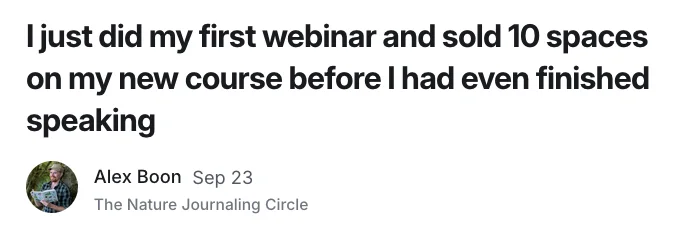
Alex Boon, a nature journaling creator in the Accelerator, ran his first webinar and sold 10 spaces on his new course before he’d finished speaking. That’s $2,000+ in two hours, from ten people.
Low ticket needs reach. High ticket needs trust.
Here’s the low ticket / high ticket business model, the short version. A low-ticket shop needs a lot of buyers, which means a lot of reach. A high-ticket offer needs a handful of people who really trust you.
And you don’t have to pick one. If you wanted to speed run six figures, you could do it with three offers, ideally built in this order:
- Low ticket: probably under $100. Start here and build confidence.
- High ticket: $500 plus. Go hard. Think about what value you could really bring to the table.
- Medium ticket: somewhere in the middle. Maybe $250, maybe $400. Fill the gap.
What you’re building is a ladder, where folks can get a taste of what you offer and then keep climbing upwards if they want more.
In my opinion, the strongest effects come from mixing business models, too (retail, education, services). Each one covers the downsides of the others. A retail-only shop eventually exhausts the people who already follow you, and then the only way forward is growing your audience. (The whole breakdown is in the three creative business models.)
Why do I have followers but no sales?
Every piece of content you post sends out a signal, and you attract the people who are attuned to that frequency.
The content you post selects for the audience you build.
Tutorials, time-lapses, process breakdowns. All of that pulls in students, and educational content ALWAYS blows up, so most creatives lean into it. But students want to BE you. They don’t want to buy your work. So you end up with thousands of followers and a shop that never gets sales.
The difference between an artist with 5K followers and a waitlist, and an artist with 50K followers and an empty shop, is almost always this. (How to fix it is in bond content.)
And the other half of it: no matter how many views you’re getting, people won’t buy if they don’t know what you’re selling. That it exists, what it is, who it’s for and how it can help them. People only ever see a fraction of what you post. On a good day, maybe 10% of your followers see any given post.
So if you want more sales, you have to sell more consistently. You might be able to 10X your business just by selling to the followers you already have.
Joseph’s results came from in-person selling, not a follower milestone. He made $8,775 in two Ren Faire weekends, more than all of last season.
In this economy, to see doubling of revenue is crazy to me. It means that what I’m doing is working - it’s not just luck.
 Joseph Zhou · dark fantasy artist
Why didn’t art school (or the gallery) teach you any of this?
Because almost nobody does.
Pricing. Email lists. Launches. Reading your own numbers. The entire business half of a creative business. You know how to make the work. Nobody ever taught you the rest.
I didn’t go to art school. I have a degree in political science that was almost fully paid for by a needs-based scholarship, and I took oil painting classes in college alongside it. Zero minutes of those painting classes were about how to sell one. But I have PLENTY of friends who did go to art school.
And do you know what those friends say? Art school didn’t teach them ANYTHING about running a business. It gave them tens to HUNDREDS OF THOUSANDS of dollars of debt. And then they graduated and found out that degrees weren’t nearly as important as their portfolios.
I’ve never heard of an art school that teaches basic sales copywriting. We’re taught how to make art, and then… nothing. Plus a lot of messaging that mixing art and commerce is “impure.”
I think the “starving artist” trope is a self-fulfilling prophecy, and institutions like art schools keep it going by skipping the basics of entrepreneurship.
(To be fair, I don’t hate the idea of art school. For some people it can be a super valuable experience. I’m talking about the system, not the teachers.)

Galleries won’t do this part for you either
In 2018, I was in college and finally taking my art seriously. I made a cohesive body of work, applied to galleries and shows, and got into quite a few of them.
My work didn’t sell. Nobody knew my name, and I didn’t have time to post between classes and work-study. No gallery was going to do that part for me.
So I started reading business books. I realized I couldn’t afford to NOT learn business.
Most advice for creatives is about getting seen. Almost none of it is about getting paid. Post every day. Use the right hashtags. Go viral and the rest sorts itself out. None of that is wrong, exactly. It’s just all about attention.
So how many followers do you need?
The number your offers and prices require. That’s it.
Take your income goal, list every product with its price, and figure out how many of each you’d need to sell every month. Then work backwards to the views (and the followers) that takes. I walk through every step in art business math, and the free Creative Money Map does the math for you.
If the answer is “a lot more followers than I have,” look at your prices before you look at your posting schedule. (For raising them and holding the line, read stop undercharging for your art. If you’re starting from zero, how to sell art with no followers.)
the business half nobody taught you…
The Creative Accelerator
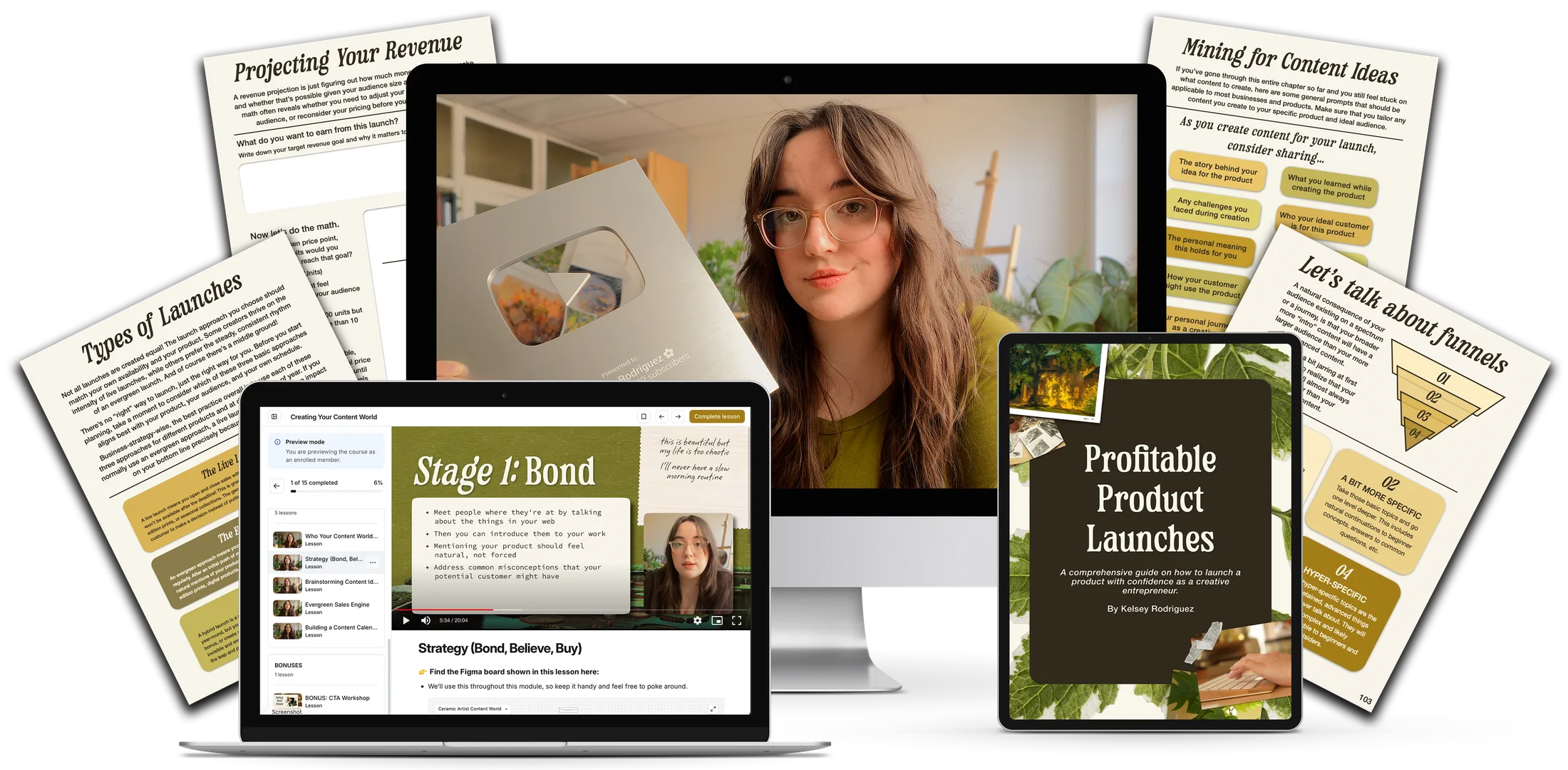
A year of hands-on support for creatives scaling to six figures. We build your offers, run your numbers every month, and sell to the followers you already have. Group coaching twice a month, co-working every other week, my feedback on your content, and every course I make.
Learn moreJoseph, Alex and a lot of other artists did this without waiting for a follower milestone. Their numbers are on the student wins page.
Talk soon,